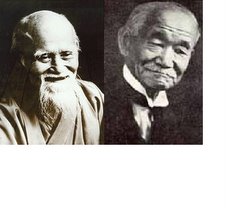
At Pat's behest, I made a few labels so my readers can look over some of my older posts that deal less with the technical aspects of Aikido or Judo, but are just entertaining or thought provoking for me. I'm going back over the older ones and putting updated comments as I look back over my old musings. Also, my Einstein quote I found but did not see my John Adams quote. Therefore, here it is:
“I must study politics and war, that my sons may have the liberty to study mathematics and philosophy, natural history and naval architecture, in order to give their children a right to study painting, poetry, music, architecture, tapestry, and porcelain.”
Monday, May 11, 2009


Saturday, May 9, 2009
Question about blogspot
I've looked around and could not find a way to make a separate archive for certain posts. A way to organize them into "Posts about this" and "Posts about that". Does anyone know how to do that?
Thursday, May 7, 2009
On a Related Note...
I've been thinking about my last post and it reminded me of something. Continuing on that train of though concerning perception, there's a point where you need to question what you're looking for when you train. There's a common time, usually after yellow or green belt where the student knows enough to be confident in their abilities, but not enough experience to keep from getting over-confident. They start getting over confident and are sure they have a firm grasp of understanding what's happening as they continue to train. This can be a serious problem should their abilities get tested and the outcome not turn out as they expected. I'm no exception to this. When I was in the Marine Corps a lifetime ago, there used to be a class on grappling in one of the schools I attended. Everyone learns basic movements in boot camp from the Marine Corps Martial Arts program (MCMAP). Well I was sure I had an edge thanks to my Judo training (I think I was a green belt at the time). So I'm watching people and thinking to myself "Oh, that guy's weak on his back, that guy obviously doesn't know what he's doing" etc. When it comes my turn to grapple I can win the matches against people who'd never done any of this before, but the guys who were high school wrestlers, or significantly larger than me were wiping the floor with me. I had it in my head that my training must've failed me, or that it just didn't work outside of the rules structure of Judo matches themselves. There was a week long break in our training and I took that opportunity to return home for a few days, then the grappling class would resume for the next 2 weeks after I came back. So I show up at Pat's dojo, and start yelling at Pat, saying things like "this training doesn't work against wrestlers, I haven't learned anything" and so on. Pat patiently listens to me then says "well, let's do some randori and see if we can't figure it out" and promptly beats me mercilessly for an hour. After I was exhausted he simply said "You've forgotten your basics. You're not shrimping and you keep trying to make moves work." I went back and beat everyone in class including the instructor. I've told this story before, but there's another part of it I didn't emphasize the past time or two. When I went back, it wasn't my perception of techniques that changed. It was my immediate goals I altered. I didn't want to be the "best" anymore, I just wanted to be better than what I was. The only thoughts going through my head when actually grappling were "ok, here I am, now what?" I wasn't trying to get an armbar or a choke, I just concentrated on what WAS, and things just happened. I started trying not to lose instead of trying to win. My opponents would get so caught up in trying to beat me that they in turn would put themselves in a position where they might as well have taken my hands and just placed them around their neck. The point is, should you reach a point in your training where your training comes into question and you feel like you fail, think about what you were trying to achieve in the first place.
Wednesday, May 6, 2009
Probabilities
Last night one of my students made a comment about using Aikido against an attacker with a knife and how you'd be safe as long as you used Aikido. When I commented "well, you'd be safe-ER" I got some questioning looks. In Aikido we train to prevail and increase our odds of safely getting out of a confrontation. We're never 100% sure we'll be fine, and that's especially true when someone has something lethal, like a knife. Even untrained, someone with a knife has a VERY good chance of cutting and/or stabbing you. We try to lessen their chances and increase our own by training in avoidance, having a good understanding of mai, and maintaining balance. I could see the disillusionment setting in. In martial arts we get this idea of being invincible due to getting a sort of tunnel vision thanks to training. We think "well this works in class and I can do this" but somehow this translates into our brains as "this works and as long as I do this I can never be hurt". I'm not saying confidence isn't good to have, I'm just saying that we need to think about our goals. If our goal is to "take this knife away from this guy and walk away without a scratch" that's a hard goal to meet. Now if it's something closer to "I want to survive this" or "I want to get away" that's something much more attainable and realistic. This is also why I keep telling students not to try to make a specific move work. When you do that, you have a habit to foget about everything else you can do also. This post came out sounding more pessimistic than I'd hoped but hopefully I've explained myself well enough to get my ideas across to you guys.
Thursday, April 30, 2009
Ideas and Movement
Tonight in class some of my students were having trouble making the turn in honasu number 6. I mentioned that whatever is going through your mind while doing the technique will affect how you do it. Personally, when I do the turn I think about projecting out with my arm and the turn comes naturally. We played around with doing number 6 that way, then tried thinking about just our feet, then tried making a wide arc with the arms. The results were very different in each attempt. We moved back to tegatana from there doing the first few movements over a few times trying to see how different our bodies moved depending on what was going through our noggin at the time.
Tuesday, April 21, 2009
What is Aikido
Tonight in class I was asked at two different times by two different people "what is Aikido?" and I didn't have a satisfactory answer. Not satisfactory to me I should say. A little history lesson (and please correct me if I'm wrong): When O'Sensei was passing away, his son and the head teacher of the Hombu dojo at the time, Koichi Tohei had different ideas of what Aikido was or should be. Tohei thought Aikido was more a breathing meditative excercise and required less physical practise. Ueshiba (O'Sensei's son) wanted to carry on the teachings of his father in the same way he was taught. Until tonight I thought Tohei was crazy taking the emphasis of movement out of Aikido. While I still disagree with that generally, I think I understand the idea better. Allow me to elaborate: Aikido has always been there for my good days and bad days. Whether it was raining, or flooding, or a drought, or hot, or cold...the dojo was always there. We still dressed in our gi's, the mats were still blue, the sweat still came, the movements still came. The Aikido I do, is the same martial art my teacher learned in college, that his teacher's teacher learned decades ago, the same my kids will learn one day. It's a timeless tangible thing that makes me forget for the duration of class any problems I might have had that day, or worries of things I need to do after class. That itself is the greatest asset Aikido has been in my life. The odds are I'll never get into a gang fight against guys carrying chains and knives, or use it against the bully quarterback and end up with the cheerleader like in a Hollywood movie. I'll use my falling practise when I slip on ice or trip over a coffee table corner, but I'll use the stillness and calming effect it has on me every class I teach or attend. That aspect of Aikido, the stillness, is just as important to me as any throw or joint-lock. I think THAT is was Tohei wanted to capture and focus on exclusively and I don't think it's a fruitless endeavor. That's also the hardest concept to get across to people. I don't like describing Aikido without including that part. That is partly what Aikido is to me, but how to do explain THAT part to other people?
Tuesday, April 14, 2009
Tough on the Teacher
Class wasn't as good as it has been lately. It wasn't especially bad tonight, we went over Honasu number 6 and tegatana. It's just getting difficult to keep things interesting doing the same moves over and over.
Subscribe to:
Posts (Atom)